
Fresh pasta
Fresh Pasta Made Daily: Trafila al Bronzo
Follow Davanti’s daily fresh pasta from dough through a bronze die, and learn how surface, shape, sauce, and Italian tradition meet in the bowl.
Before a plate of pasta reaches the dining room at Davanti, there is another service already underway. Flour and liquid become dough. The mixture is worked to the structure required for the shape, then formed. Trays fill. Water comes to a boil. Sauces are prepared for the particular forms they will meet.
We make our fresh pasta daily, and for our extruded shapes we use a trafila al bronzo—a bronze die. The phrase appears often on pasta packaging and menus, yet its meaning is more physical and more interesting than a stamp of “authenticity.” It names a tool, a method, and a choice about texture.
The trafila is a gateway, not a knife
A trafila is a perforated matrix through which a material is forced. In pasta making, the openings in that matrix give the dough its cross-section. A round opening can produce a strand. A die fitted with an internal core can form a tube; a more elaborate profile can produce a curl, ridge, spiral, or shell-like shape.
The die therefore does not simply cut one generic pasta into different lengths. It designs the pasta from the moment the dough emerges. A separate blade may determine length, but the trafila determines much of the geometry.
This is one reason shape names matter in Italy. A pacchero is not just a large piece of pasta. A fusillo is not merely a decorative twist. Whether pasta is extruded, rolled, or cut, its shape changes the way it meets a condiment. Tubes create an interior space for sauce. Spirals form edges and channels. Broad ribbons offer an expanse on which a finely textured ragù can settle. Each shape changes the balance of pasta and sauce in a bite.
The Italian word carries an accidental poetry, too. In everyday speech, trafila can mean a long sequence of steps or formalities. Pasta passes through a literal trafila, but the finished bowl also represents a figurative one: selecting flour, mixing, extruding, cutting, holding, cooking, saucing, and serving.
What the bronze changes
The material of the die affects the pasta’s surface. Italian production references describe bronze dies as giving pasta a rough surface, and controlled studies of dried spaghetti have measured a rougher surface after bronze extrusion than after extrusion through smooth PTFE-lined dies. Under magnification, the difference becomes a landscape of tiny irregularities.
At the table, that roughness is often visible as a more matte, tactile surface rather than a polished sheen. Cooks prize it because sauce can spread across and settle into that textured exterior. The protected specification for Pasta di Gragnano even connects bronze dies with the pasta’s characteristic coarseness and its ability to meet and retain condiments.
It is worth being precise about the claim. Researchers can measure surface roughness directly. The idea that rougher pasta “holds sauce better” is a well-established culinary purpose and tradition, but sauce behavior also depends on starch, cooking, emulsion, the thickness of the condiment, and how the pasta is finished in the pan. Bronze is important; it is not magic.
Think of the surface as an invitation. A smooth shape gives sauce one kind of path. A textured surface changes the way sauce coats the pasta. The cook still has to bring pasta and condiment together properly.
Fresh and bronze describe two different choices
“Fresh pasta” and “bronze-die pasta” are sometimes used as though they mean the same thing. They do not.
Freshness concerns moisture, perishability, and when the pasta is made and cooked. Trafila al bronzo concerns the way a dough is formed and the surface created by the die. Fresh pasta can be rolled into sheets, cut with a knife, shaped by hand, filled, or extruded. Bronze-die pasta can be fresh, as it is at Davanti, or dried for storage.
Bronze extrusion and drying are separate production choices, even though packaged-pasta descriptions often mention them together. Low temperatures and long drying times concern dried pasta, not the fresh pasta made for Davanti’s daily service.
Fresh pasta does not have one compulsory national formula either. Some northern traditions are strongly associated with soft wheat and eggs; many southern traditions grew around durum wheat and water. Filled pastas, hand-shaped forms, sheets, and extruded shapes overlap those broad tendencies. Italy’s pasta culture is a map of local solutions, not a single recipe enlarged to the size of a country.
Shape is part of the sauce
When Italian cooks pair pasta and condiment, shape is part of the recipe. The decision can be practical, regional, or both.
A slow-cooked meat sauce benefits from a form that catches its small pieces and glossy cooking juices. A smooth, delicate condiment may suit a thinner strand. A thick tube can frame a robust sauce inside and out. A spiral presents edges and hollows that carry sauce differently through each bite.
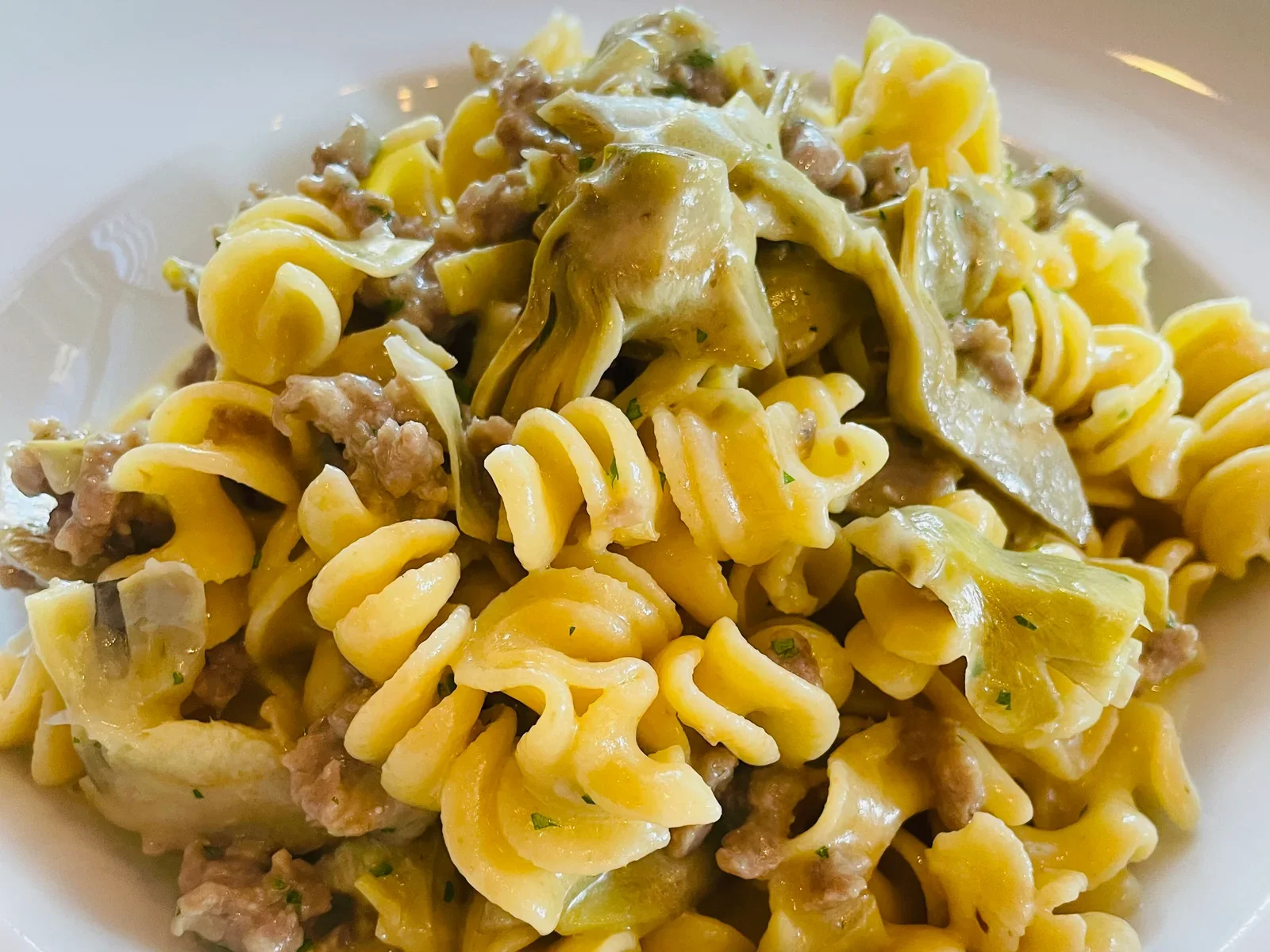
Davanti’s Fusilli con Carciofi e Salsiccia makes the idea easy to see. The twists create ledges for sausage and sauce while pieces of artichoke sit among the curves. In Paccheri al Sugo di Costine alla Napoletana, wide tubes give a long-cooked rib ragù enough structure to feel generous without losing the identity of the pasta.
Neither relationship is accidental. The pasta is not an empty vehicle underneath the “real” flavor. Its wheat aroma, thickness, surface, and bite all take part in the dish.
Gragnano and a town shaped by pasta
Bronze dies have an especially visible place in the history of Gragnano, a town near Naples whose dried pasta carries protected geographical status in the European Union. The Pasta di Gragnano IGP specification requires durum-wheat semolina, local water, bronze dies, and drying within the defined production area.
Davanti’s fresh pasta is not Pasta di Gragnano IGP; the protected name belongs to that place and its complete process. Gragnano is valuable here as a cultural example of how seriously Italy can treat the relationship among tool, climate, town, and food.
The specification describes a nineteenth-century town whose streets and buildings were arranged to favor air circulation and help pasta dry. Pasta was not simply produced inside isolated workshops. It influenced the urban landscape. Rows of hanging strands, local wind, and the knowledge of pasta makers became part of one system.
Bronze dies also encouraged creativity. Change the opening and a cook can change the way a sauce is gathered, how the pasta feels between the teeth, and even how it looks on a family table. A piece of metal becomes a form of culinary design.
Daily work, not a decorative phrase
Making pasta daily means repeating the work for each service day and paying close attention to consistency from one batch to the next.
The bronze die adds another layer of intention. Its job is not to make every pasta the same. It makes distinct shapes possible while giving their surfaces a particular character. The result should still taste of grain, meet the sauce cleanly, and retain enough structure to make every bite satisfying.
What to notice in your next bowl
Start with the surface. Is it glossy and smooth, or slightly matte and textured? Then look at the shape. Where can the sauce collect? Does it sit inside a tube, along a ridge, around a twist, or across a broad ribbon?
When you take a bite, notice how the sauce coats the surface, then whether the pasta’s gentle wheat flavor and structure remain present. A good pairing feels complete because no part is waiting for the other to become interesting.
That is the practical lesson of trafila al bronzo: surface and shape influence how pasta meets its sauce. At Davanti, making fresh pasta daily keeps that relationship close to the kitchen that forms each batch.
Learn how filled shapes differ in our guide to ravioli, tortellini, agnolotti, and casoncelli, explore Italy’s regional ragù traditions, or see today’s dishes on the menu.
Culinary details reviewed by Oliver Calza, Davanti Co-Founder.