
Italian cheese
Inside Burrata: How Mozzarella, Stretched Curd, and Stracciatella Relate
A careful look inside burrata explains its stretched-curd shell, creamy stracciatella center, protected Apulian identity, and kinship with mozzarella.
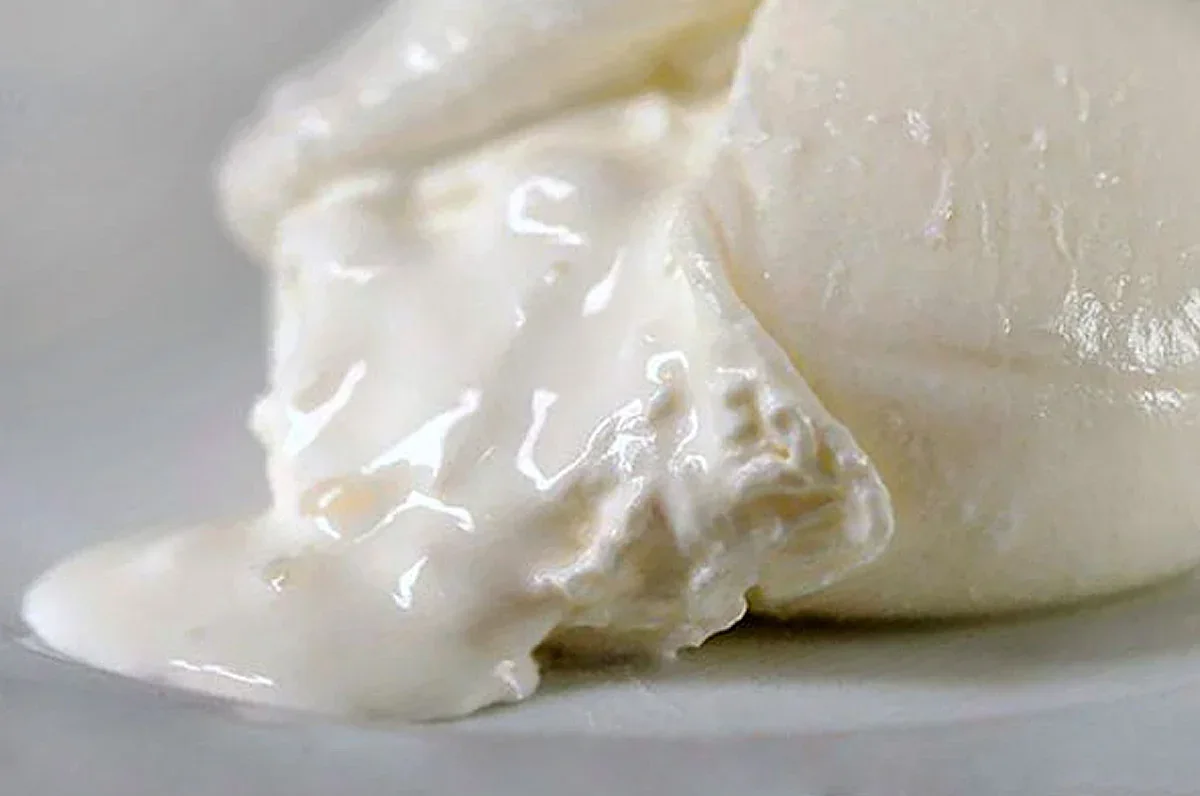
Burrata saves its explanation for the knife. Before cutting, it resembles a smooth white pouch gathered at the top. The first slice reveals that the outside and inside are doing different jobs: an elastic shell keeps the shape, while creamy strands loosen across the plate.
That contrast has made burrata famous, but it has also blurred three related terms. Mozzarella, burrata, and stracciatella are not three names for the same cheese. They share stretched-curd technique, yet their structures—and therefore the experience of eating them—are distinct.
The protected specification for Burrata di Andria IGP provides the clearest way to look inside. It describes a cow’s-milk cheese made from cream and pasta filata, or stretched curd. The shell is stretched curd formed into a pouch. The filling is stracciatella: pieces of stretched curd torn into strands by hand and immersed in cream. Burrata is the complete construction; stracciatella is its soft center.
Pasta filata is the common language
The phrase pasta filata literally points to curd that has been stretched. In this family of cheesemaking, heat and working turn curd into a cohesive, pliable mass. The maker can pull and fold it, then shape it while it is still responsive.
Mozzarella is perhaps the most familiar expression. The product specification for Mozzarella di Bufala Campana DOP describes a porcelain-white cheese with a very thin, smooth exterior and an interior formed in fine layers. That protected mozzarella is made from buffalo milk in its defined production area. Other mozzarellas may use cow’s milk and belong to different traditions or standards.
The distinction matters because “mozzarella” is a broad word in everyday conversation, while a protected name such as Mozzarella di Bufala Campana DOP identifies a specific product governed by a specification. Likewise, not every cheese sold simply as burrata can be assumed to be Burrata di Andria IGP. The protected name carries requirements for ingredients, method, geography, packaging, and labeling.
Technique links these cheeses, but the final architecture separates them. Mozzarella is shaped as the stretched-curd cheese itself. Burrata turns part of that pliable curd into a container and gives it a second texture within.
Stracciatella is made by tearing, not melting
Inside the protected Apulian cheese, some stretched curd is reduced to irregular ribbons by hand and cooled. Cream surrounds those ribbons, creating the soft mass called stracciatella. Regione Puglia explains that the name follows the action of stracciare—to tear or shred.
The strands matter. Stracciatella is not simply cream added to a mozzarella ball, nor is it a smooth cheese sauce. The filling preserves a tactile difference between dairy liquid and pieces of curd. When a burrata is opened, cream can flow while the ribbons remain visible and slightly resilient.
The same filling may be served on its own and called stracciatella, but in burrata it is enclosed. That shell changes how the cheese arrives and how it is shared. The intact pouch creates anticipation; cutting releases the center; bread, tomatoes, vegetables, or pasta can catch both cream and strands. Form becomes part of service.
Why the outside cannot be an afterthought
It is tempting to treat the shell as packaging for the more luxurious center. Yet the shell supplies the tension that makes burrata complete. Its smoother, firmer chew frames the loose filling and gives each portion more than one texture.
The protected method divides one stretched-curd preparation between these two purposes. One part is shredded for stracciatella. The remainder is shaped into pouches, filled, closed at the neck, sealed, and cooled. The maker therefore has to manage elasticity at several moments: enough to form an even shell, enough to hold the filling, and enough delicacy that the pouch still yields pleasantly when eaten.
The current Burrata di Andria IGP specification ties production and packaging to the territory of Puglia. It also treats the cheese as a fresh product with limited keeping time. That freshness is structural, not a marketing flourish. The filling is deliberately moist, and the shell is valued for a tender, dairy-forward character rather than long maturation.
An origin story worth labeling as a story
The consortium and Regione Puglia preserve an oral account in which an Andria cheesemaker, Lorenzo Bianchino, devised burrata during heavy snow in the early twentieth century. Unable to move fresh milk and cream easily, he is said to have enclosed cream and scraps of stretched curd inside a pouch, adapting the logic of another local dairy preparation.
It is an appealing story of thrift and skill, and the regional account notes an early published reference in a 1931 Touring Club guide. Still, the snowstorm narrative is presented as oral tradition, not as a complete documentary record of invention. Keeping that distinction does not make the cheese less meaningful. It places the emphasis where the evidence is strongest: Andria’s cheesemaking culture, Puglia’s protected production, and the distinctive method that makers continue to practice.
Three textures, three identities
Set the terms side by side and the relationship becomes clear. Mozzarella demonstrates the supple body of stretched curd. Stracciatella separates that curd into cream-soaked strands. Burrata brings the two together as shell and center. They are close relatives, not substitutes with different labels.
That structure also tells a diner how to pay attention. Notice the resistance of the outside before the cream moves. Look for strands rather than a perfectly smooth interior. Taste how a mild shell, rich filling, and any surrounding condiment share the same bite.
The archive photograph above records a close view associated with a past Davanti special; it does not establish a protected designation, producer, milk source, or current availability. Our archive page for Conchiglie con Burrata e Acciughe alla Pugliese preserves that earlier presentation. For what is available now, visit the menu or current specials.
Culinary details reviewed by Oliver Calza, Davanti Co-Founder.