Italian cheese
Parmigiano Reggiano and Grana Padano: Two PDO Cheeses, Not One Style
Compare Parmigiano Reggiano and Grana Padano by place, ingredients, aging, markings, and flavor—without treating these two PDO cheeses as interchangeable.
Parmigiano Reggiano and Grana Padano are both hard, granular cow’s-milk cheeses from northern Italy. Both carry the European Union’s Protected Designation of Origin, or PDO, seal. Both can arrive at the table in a wedge, a shower of fine gratings, or brittle flakes. That family resemblance is real, but it does not make the names interchangeable.
The useful question is not “Which one is the real Italian grating cheese?” Both are. A better question is: what does each protected name tell us about where and how the cheese was made?
PDO is a production promise
A PDO name ties a food to a defined place and a registered method. The specification governs more than the words on the front of a package: it establishes the production area, raw materials, processing rules, maturation, and controls that a cheese must satisfy before it can carry the name.
For Parmigiano Reggiano, the protected area centers on Parma, Reggio Emilia, Modena, and specified parts of Bologna and Mantua. Grana Padano’s production territory is broader, stretching across much of the Po Valley and several northern provinces. Those boundaries matter because the milk supply and production steps are linked to each cheese’s own territory.
“Grana” itself refers to the grainy structure of this family of cheeses. Parmigiano Reggiano and Grana Padano are therefore close relatives, not a branded product and its generic copy.
The ingredient lists begin alike, then separate
The current Parmigiano Reggiano specification describes a hard cheese made from raw cow’s milk, partially skimmed by natural creaming. The consortium’s labeling guidance reduces the ingredient statement to three essentials: milk, salt, and calf rennet. Additives and preservatives are not permitted.
Grana Padano also begins with raw cow’s milk that is partially skimmed by allowing cream to rise. Its specification and consortium guidance list milk, salt, rennet, and lysozyme. The consortium explains that lysozyme, a protein derived from egg white, is used to control unwanted fermentation associated with some permitted cattle feed; it is not used in every Grana Padano type, with Trentingrana identified as an exception.
That difference is practical information for diners, especially anyone managing an egg allergy. It is not a shortcut for declaring one cheese more “natural” or more authentic. Each name has its own authorized specification, and the ingredient line on the package remains the clearest guide to the piece in hand.
Twelve months and nine months are starting lines
Parmigiano Reggiano must mature for at least 12 months before it can be sold under its PDO name. Grana Padano reaches its first inspection after at least nine months. Wheels that meet the respective requirements receive identifying marks; wheels that do not qualify cannot simply keep the protected name.
Minimum age is only the threshold. Producers sell both cheeses at later maturities, and time changes the eating experience. A younger wheel can feel more yielding and milk-forward. With longer maturation, moisture falls, the paste becomes more friable, and savory, toasted, or broth-like notes may become more pronounced. The consortium for Grana Padano, for example, distinguishes younger cheese from “Riserva” maturities after additional aging and control.
This is why comparing a nine-month Grana Padano with a 36-month Parmigiano Reggiano does not isolate the difference between the two PDOs. It also compares very different ages. For a useful tasting, read both the protected name and the maturation statement.
The rind and package carry evidence
On a full wheel, repeated markings in the rind record identity at the source. Parmigiano Reggiano is associated with its pin-dot inscription and selection mark. Grana Padano uses its own repeating lozenge pattern, dairy information, and fire brand after inspection.
Most diners meet the cheeses as cut wedges, so the retail label becomes essential. Look for:
- The complete protected name, not simply an Italian-looking phrase.
- The red-and-yellow EU PDO emblem.
- A maturation statement when one is provided.
- The ingredient and allergen declaration.
- Traceability details from the producer, packer, or dairy.
These signs establish identity. They do not promise that every wheel will taste identical. Season, dairy, herd, maturation room, and age can create variation within the rules.
Choose by the job, not by a scoreboard
There is no honest universal winner. A younger, gentler cheese may disappear gracefully into a filling or sauce. A long-aged wedge may deserve to be broken into uneven pieces and tasted slowly. Fine grating spreads flavor across a plate; broad shavings make the cheese a distinct texture.
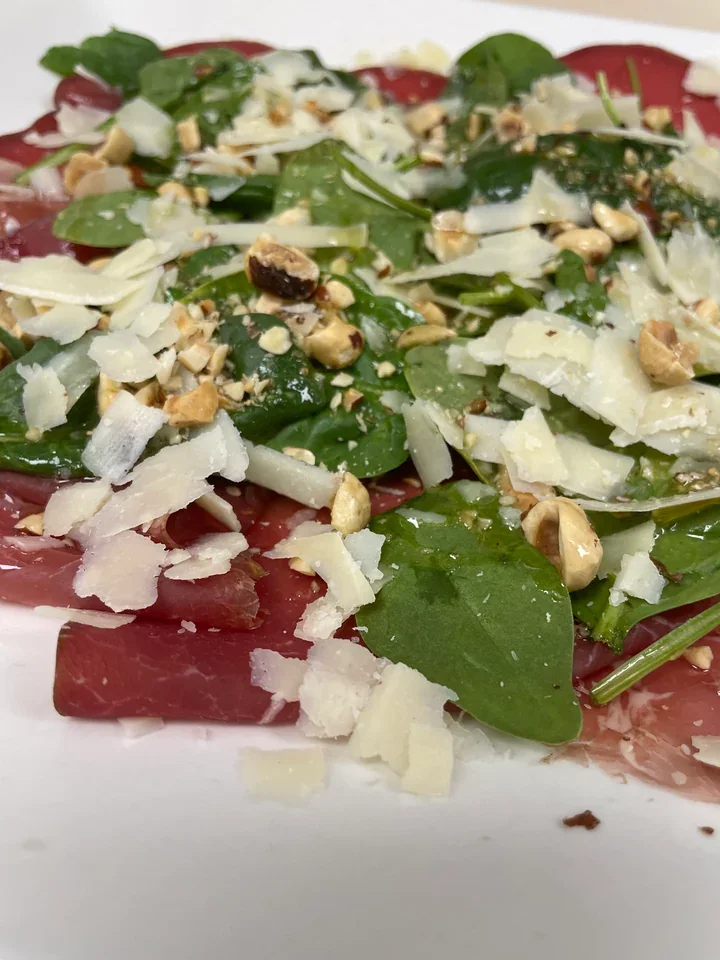
The photographed dish comes from Davanti’s documented weekend archive: Bresaola della Valtellina with spinach, hazelnuts, and Parmigiano. The image grounds this guide in a real Davanti plate, but the article does not imply that every menu preparation uses the same cheese or maturation. Current ingredients and availability should always be confirmed from the menu or with the restaurant.
The shortest answer
Parmigiano Reggiano and Grana Padano belong to the same broad family, but their PDO rules define different territories, ingredient allowances, and minimum aging periods. Read the full name, age, markings, and ingredient list. Then taste the cheese in front of you instead of asking either protected tradition to stand in for the other.
Culinary details reviewed by Oliver Calza, Davanti Co-Founder.