
Italian baking
Panettone and Colomba: Italy’s Holiday Breads from Christmas to Easter
How patient fermentation, Milanese history, and the Italian calendar connect panettone at Christmas with colomba at Easter.
An Italian holiday bread tells time before it tells a recipe. Panettone rises into view as Christmas approaches; colomba follows when the calendar turns toward Easter. Both are celebratory breads made luxurious by patience. Their tall or winged forms make the season visible, while their tender, fragrant interiors turn a family table into an occasion.
The connection between them is real, but it is not a story of two identical doughs wearing different costumes. Italy’s official definitions give each bread its own shape and character. Their histories also move at different speeds: panettone grew with Milan over centuries, while the colomba familiar across Italy today belongs largely to the twentieth century.
Understanding that difference makes both traditions more interesting.
Panettone begins as an enriched bread
The City of Milan describes panettone as an enriched bread tied to the city’s Christmas rituals. Municipal sources place written evidence in the seventeenth and eighteenth centuries, when ingredients such as butter, eggs, and candied fruit made a festive loaf distinct from everyday bread. By the nineteenth century, panettone had become a recognizable Milanese Christmas sweet.
That progression matters. Panettone did not appear fully formed in one dramatic moment. It developed within a culture that marked feast days by enriching the staple food of daily life. Flour became a canvas for eggs, butter, fruit, sweetness, and time—ingredients and labor that announced abundance because they exceeded what an ordinary loaf required.
The Italian government now protects the name through a national standard. The 2005 decree published in the Gazzetta Ufficiale defines panettone as a soft baked product made by natural fermentation from sourdough, with a round base and a cracked upper crust. It also establishes required categories of ingredients and a production process that includes fermentation, shaping, rising, baking, and cooling.
That legal definition establishes a shared foundation without erasing differences among bakers. Within it, the baker still makes countless judgments: the health of the culture, the strength of the dough, the pace of fermentation, the distribution of fruit, and the moment when a loaf has risen enough to meet the oven.
Why the crumb feels unlike cake
Panettone may sit with desserts, but its structure comes from breadmaking. A strong, elastic dough must hold both enrichment and the gases produced during fermentation. Given time, that network stretches into a light interior whose strands pull apart rather than crumble like a simple butter cake.
The pleasure is a sequence of contrasts. The outside is deeply browned and aromatic. Inside, the crumb is soft, springy, and gently chewy. Sweetness arrives with the fruit, while fermentation and butter provide a longer, rounder aroma. A good slice feels generous without becoming heavy because so much of its volume was built slowly from air.
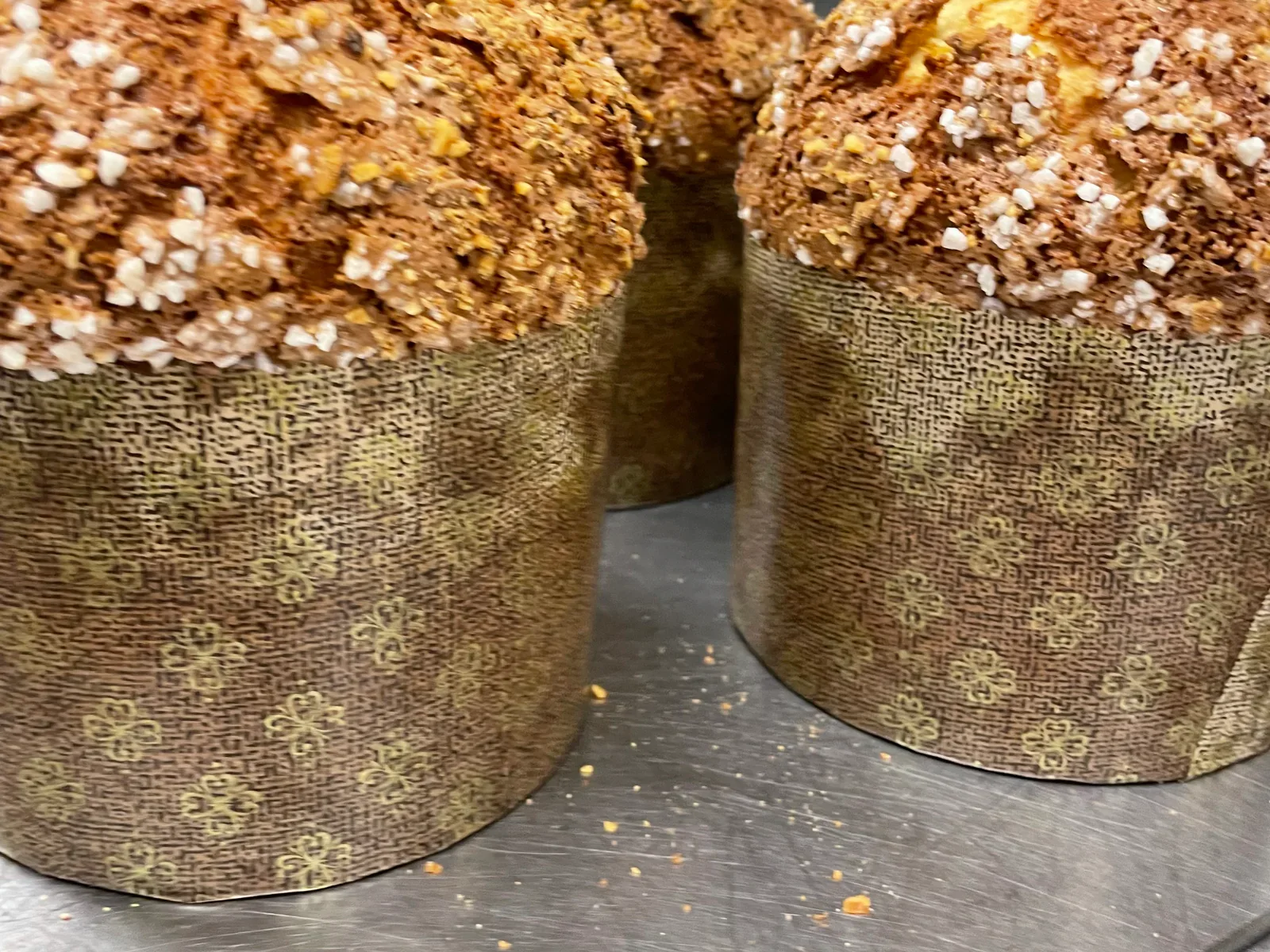
The finished panettoni in Davanti’s archive photograph show the scale of that transformation. Each loaf has climbed above its paper mold and opened into a rugged crown. The photograph documents the finished breads, not a complete ingredient list or production claim. What it does reveal is something every baker recognizes: fermentation leaves visible evidence.
For readers interested in the grain and technique behind our kitchen, our journal also explores the flour Davanti selects from Brescia and why fresh pasta texture begins before the sauce.
A famous origin story—and what history can actually support
The best-known panettone legend takes place in the court of Ludovico il Moro. After a banquet dessert fails, a kitchen assistant named Toni is said to rescue the meal with a sweet bread; pan de Toni then becomes panettone. Versions change the hero’s role and motive, which is a clue that we are hearing folklore rather than a documented invention record.
Milan’s own historical programming presents the Sforza-kitchen tale as a legend. The firmer history is gradual: festive enriched breads existed earlier, panettone became typical of Milan in the nineteenth century, and Angelo Motta helped reshape its commercial life in the early twentieth century. Industrial production carried the tall loaf far beyond Lombardy, making a city tradition part of Christmas tables throughout Italy and eventually around the world.
The legend still has cultural value when it is labeled honestly. It expresses ideas Italians recognize in holiday cooking: avoid waste, improvise under pressure, feed the table, and let a shared dish outlive the person who first made it. It is a story about what panettone means, not proof of who invented it.
Colomba carries the same patience into spring
Colomba—Italian for “dove”—belongs to Easter. Its broad, irregular oval form suggests a bird in flight, and its glazed surface gives a crisp counterpoint to the soft interior. The same 2005 decree that defines panettone gives colomba a separate standard, including natural sourdough fermentation, its characteristic shape, and a glazed, decorated top.
Popular legends push dove-shaped Easter breads back to Lombard kings or to Saint Columbanus. Italia.it presents those accounts as legends, not settled origin history. The widely distributed modern colomba has a much clearer twentieth-century story: in the 1930s, the Milanese company Motta used its panettone-making knowledge and equipment to create a spring product for Easter. Its success helped turn a modern commercial idea into a national seasonal custom.
Calling that history “modern” does not make the tradition less meaningful. Traditions are not valuable only when they are ancient. They become traditions because people repeat them, attach memory to them, and use them to mark time. Colomba’s dove shape also gives the table an immediately legible symbol of peace and renewal.
Two breads, two holidays, one Italian habit
Panettone and colomba share a baking language: natural fermentation, enriched dough, aromatic fruit, a delicate interior, and a surface that adds texture. Yet the calendar changes how they are read. Panettone’s height and winter richness close the year; colomba’s outstretched form announces spring and Easter.
Both also reward communal eating. They arrive whole, are cut at the table, and make sense over conversation. A slice can accompany coffee, finish a long meal, or reappear the next morning, allowing the holiday table to continue at an easier pace.
That is the deeper lesson of Italy’s holiday breads. A recipe can preserve more than flavor. Shape, season, repetition, and the act of sharing turn food into a calendar people can taste.
Explore Davanti’s current cooking on the menu, or continue through the Davanti Journal for more stories about Italy’s regions and table traditions.
Culinary details reviewed by Oliver Calza, Davanti Co-Founder.