
Culinary history
Auguste Escoffier and the Modern Kitchen
How Auguste Escoffier organized cooks, codified a professional repertoire, and used discipline to make hospitality feel effortless.
A dining room should feel easier than the work behind it.
Guests see a plate arrive at the right temperature, several people at a table served together, and a server who seems to know when to approach. Behind the doors, cooks are managing heat, timing, ingredients, equipment, and one another. The ease in front depends on precision in back.
Few chefs influenced that hidden organization more than Auguste Escoffier. His food was French, and Davanti’s food belongs to the regional traditions of Italy. His importance to us lies somewhere deeper than nationality or a list of classical recipes. Escoffier helped define the professional idea that order in the kitchen should protect quality, consistency, and the guest’s experience.
The lesson we take from his work is not hierarchy for its own sake, but hospitality made possible by preparation.
An apprenticeship that began at thirteen
Georges Auguste Escoffier was born in 1846 in Villeneuve-Loubet, near Nice. At thirteen, he began an apprenticeship in his uncle’s Restaurant Français. His apprenticeship placed him inside the physically demanding work and strict hierarchy of a nineteenth-century restaurant kitchen.
Escoffier moved from Nice to Paris and later served as a staff chef during the Franco-Prussian War. According to the museum in his birthplace, military service led him to think about feeding large groups and conserving food. Later accounts describe his kitchen brigade as drawing partly on military organization, though it was adapted to the needs of professional service.
That experience did not make the kitchen brigade a simple copy of an army. Professional kitchens already divided labor, and Escoffier inherited ideas from chefs before him. What he did was develop, refine, and put into practice a system suited to the increasingly ambitious hotels and restaurants of his time.
When cuisine met César Ritz
Escoffier met hotelier César Ritz in Monte Carlo in 1884. Their partnership later took them to the Savoy in London, the Ritz in Paris, and the Carlton in London. Ritz thought about comfort, service, design, and the expectations of an international clientele. Escoffier thought about how a kitchen could meet those expectations night after night.
Together, they helped shape a modern idea of luxury hospitality in which the room, the service, and the food belonged to one coordinated experience. Escoffier even supervised the design and organization of the Ritz Paris kitchens. He later organized kitchens on major ocean liners, where space, storage, movement, and timing had to be considered before a single meal could be served. The museum records that he joined inaugural voyages to inspect the installations and the brigade’s work in person.
At the Carlton, he directed a staff of sixty cooks. Accounts preserved by the Musée Escoffier describe him moving constantly among his office, suppliers, dining room, and kitchen. He studied what guests needed, checked the details of service, and returned after the final sitting to see what remained so food would not be wasted.
That movement reveals his role. He was not only the person with the most refined palate or the most authority at the stove. He was designing a system and then listening to it operate.
What the brigade changed
In a brigade, work is divided among stations with defined responsibilities. One cook may concentrate on sauces, another on fish, another on roasted items, another on cold preparations or pastry. A senior chef coordinates the whole, while sous-chefs translate the plan into the movement of service.
The French titles can sound ceremonial, but the practical idea is simple: people work better when they know what they are responsible for, what must happen next, and how their task fits the plate.
Specialization also creates repetition, and repetition can create judgment. A cook who works the same station learns the sound of the pan, the pace of reduction, the point at which a piece of fish will be ready, and how much time another cook needs before all elements can meet. Communication becomes shorter because the team shares a structure.
Modern restaurant kitchens adapt the old brigade constantly. In a smaller kitchen, one person may cover several classical roles. Equipment and menus have changed. Titles vary. Yet the underlying questions remain: Who is responsible? What is ready? What is waiting? When can the table’s dishes leave the pass together?
The system matters only if it serves those questions. A perfectly named station is useless if the food is late, the cooks cannot communicate, or the guest feels the strain.
A working craft placed on paper
Escoffier’s most famous book, Le Guide Culinaire, appeared in 1903. The Bibliothèque nationale de France describes the first edition as a 792-page professional reference and records the collaborators named with Escoffier, including Philéas Gilbert, Émile Fétu, and A. Suzanne.
That credit is important. The Guide did not spring from one isolated genius, and Escoffier did not invent classical French cuisine from nothing. He acknowledged the foundations built by earlier chefs, especially Marie-Antoine Carême. His project was to gather a vast working repertoire, organize it, preserve what remained useful, and adapt it to the speed and expectations of the modern restaurant.
The book’s concise entries assume professional knowledge. It is less like a beginner’s cookbook and more like a shared language among trained cooks. Stocks lead to sauces; base preparations lead to derivatives; garnishes and methods can be combined because the reader understands the foundations underneath them.
That structure helped give professional cooks a reference that could support teaching and shared understanding across kitchens.
The “five mother sauces” story needs a footnote
Escoffier is often said to have invented the five mother sauces. The tidy sentence is memorable, but culinary history is less tidy.
In the 1903 Guide, the sauce chapter identifies Espagnole, Velouté, Béchamel, and Tomate as four great base sauces. Other important emulsions and derivatives appear elsewhere in the system. The familiar classroom list of five is a useful teaching framework, but it should not be mistaken for a verbatim, timeless list introduced by Escoffier.
His more valuable lesson is the relationship between foundation and variation. Learn what gives a base sauce its structure, then understand how an added ingredient changes its aroma, richness, acidity, color, and purpose. Technique becomes a vocabulary rather than a trick.
Escoffier also insisted that complexity could not rescue poor raw materials. In his preface, he argued for refinement and adaptation while treating first-rate ingredients as irreplaceable. A sauce should support the principal food and bring the plate into harmony—not advertise how much labor the kitchen can hide inside it.
That principle travels easily from French cuisine to Italian cooking. Restraint is not the absence of technique. It is technique used clearly enough that the ingredient remains recognizable.
Discipline with a human purpose
Images of a strict brigade can make Escoffier seem interested only in command. His record is more complicated and more humane.
The Musée Escoffier documents his efforts to support employees’ families during the First World War, his charity dinners, proposals for mutual aid among cooks, and his concern with using food well rather than discarding it. He later wrote books about rice and cod intended to help people eat nourishing food at lower cost.
This does not turn the luxury hotel chef into a modern labor reformer, nor does it erase the difficult conditions of historical kitchens. It does show that his idea of professionalism included responsibility: to the guest, to the ingredient, and to the people whose work made service possible.
His famous Peach Melba offers a lighter example of the same attention. The dessert was created in honor of the Australian soprano Nellie Melba after Escoffier heard her perform. Technique, theater, hospitality, and a particular guest met in one composition. The story survives because the dish was not only sweet; it was personal.
Why Escoffier matters at Davanti
Davanti is an Italian restaurant. Our cultural reference points are Brescia, Lake Garda, the regions of Italy, Chef Roberto’s experience, and the dishes that have moved through Italian homes and kitchens. We do not claim a direct Escoffier lineage, and we do not need one.
What crosses the border is the professional ideal.
Fresh pasta made for service requires planning before the first guest arrives. A sauce must meet the pasta at precisely the right moment. A table of different dishes still expects to dine together. The kitchen must respect regional traditions while responding to the realities of a Houston restaurant. Organization makes those promises possible.
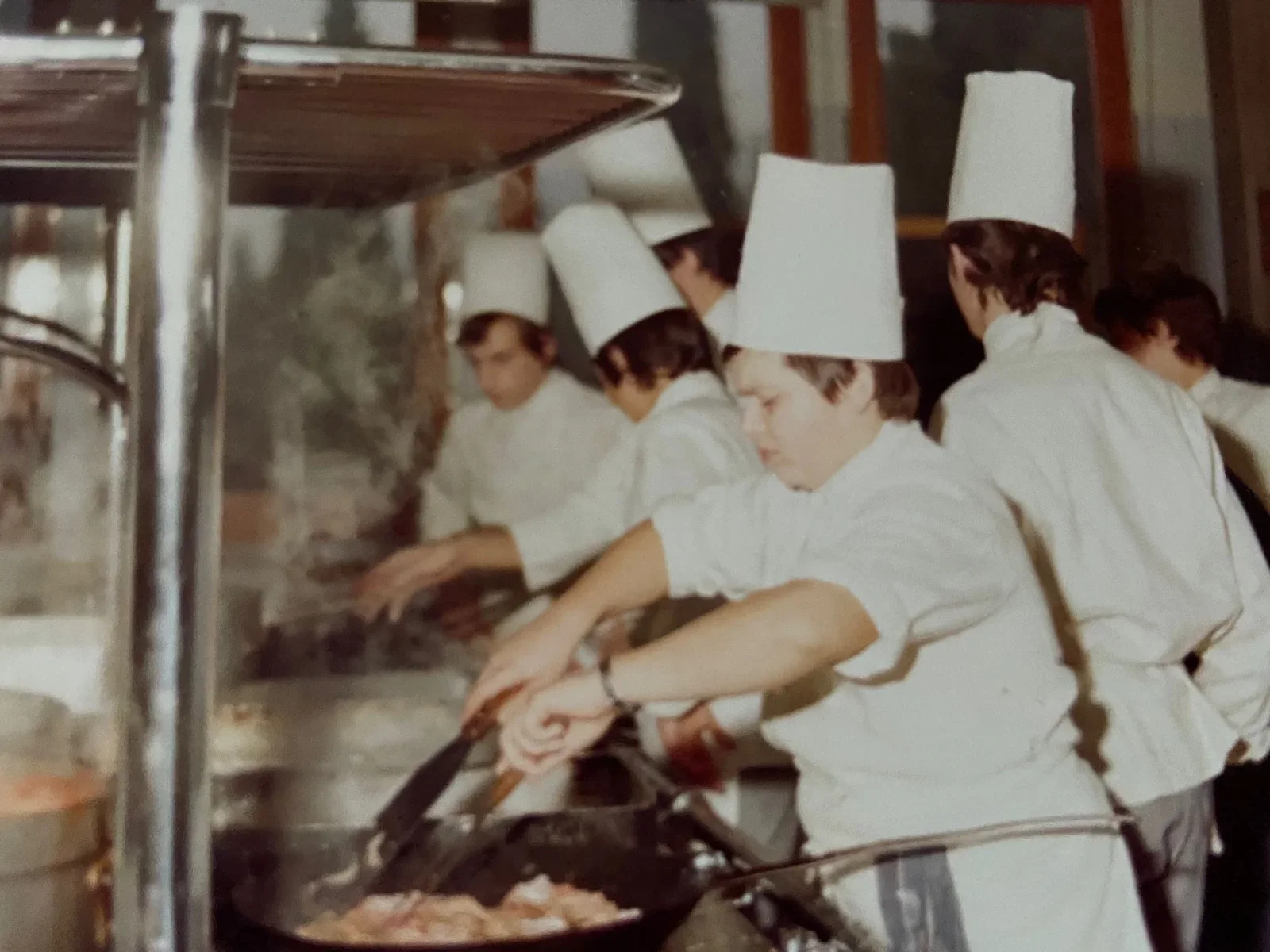
Chef Roberto’s archival kitchen photograph shows this more honestly than a portrait of one famous chef could. Several cooks share one range. Their pans overlap. Their attention moves between individual tasks and a common service. No single plate can leave well unless the group understands the rhythm.
Structure in service of warmth
Escoffier died in 1935, but the questions he organized remain alive across professional kitchens. How should knowledge be passed from one cook to the next? How can responsibility be clear without silencing collaboration? How can many moving parts produce a plate that feels composed? How can discipline create hospitality rather than stiffness?
The answers look different in every restaurant. A small independent Italian kitchen in Houston is not the Carlton in 1900, just as a modern diner is not an Edwardian hotel guest. But the best systems still disappear into the experience they support.
You should not have to see the station list, the prep schedule, the calls at the pass, or the corrections made before service. You should see a plate arrive with its ingredients in balance and feel that the table has been cared for.
That is why Auguste Escoffier remains important at Davanti. He reminds every restaurant that precision behind the scenes can create generosity in the dining room—and that organization, at its best, is another form of hospitality.
Read more about Chef Roberto and the people behind Davanti, explore the patient kitchen craft behind regional Italian ragù, or see what we are cooking on the menu.
Culinary details reviewed by Oliver Calza, Davanti Co-Founder.