Italian regions
Pasta e Fagioli Across Italy: One Humble Idea, Many Regional Tables
How pasta and beans become many different Italian dishes—from thick northern bowls to Campania’s coastal pasta e fagioli with mussels.
Ask for pasta e fagioli in different parts of Italy and the bowls may not look related at first. One is loose enough to eat with a spoon; another settles into a dense, almost creamy tangle. The pasta may be short tubes, broken lengths, small squares, or bits saved from other shapes. Some versions are lean and vegetable-led. Others gain depth from pork. Along the Campanian coast, mussels can bring the beans into conversation with the sea.
The phrase means simply “pasta and beans,” but that simplicity is a framework, not a fixed national recipe. Italy’s regions, towns, and families build around the same partnership according to local ingredients and habits.
That is why pasta e fagioli teaches more than one cooking method. It shows how Italian food creates identity through variation.
Two everyday foods make something complete
Pasta contributes grain, chew, and starch. Beans contribute earthy sweetness, a soft interior, and body. Cooked together, they change one another. Pasta releases starch into the liquid; some beans break down and thicken it further. The result can become creamy without needing to taste like cream.
The Accademia Italiana della Cucina calls pasta e fagioli a source of Italian pride precisely because every region has an interpretation. Its cultural work on legumes also emphasizes their historic importance in rural diets, where beans and other pulses provided substance when meat was not an everyday possibility. Combining legumes with bread or pasta turned stored ingredients into satisfying communal food.
That history is sometimes flattened into the phrase cucina povera. “Poor cooking” can sound as if the dish lacks something. A better reading is resourceful cooking: knowing how to draw flavor from a pot, use what the territory supplies, and make texture through technique rather than expense.
Even the bean has a layered history
It is tempting to project today’s borlotti or cannellini unchanged back to ancient Rome. The botanical history is more complicated. The Accademia notes that beans were known in antiquity, but the common bean now central to many Italian dishes arrived from the Americas after transatlantic exchange. Earlier Mediterranean cooks used other legumes, including Old World cowpea-type beans.
So pasta e fagioli is neither a preserved Roman formula nor a completely modern invention. It is a living combination that changed when new bean species entered European agriculture and were adapted to local soils, preferences, and seed traditions. Over generations, those once-new crops became inseparable from regional Italian cooking.
This is a useful reminder that “traditional” does not mean untouched by movement. Italian food history is full of ingredients that traveled, took root, and eventually became markers of place.
In the north, the bowl follows the pantry
Northern versions often reflect the beans, vegetables, and preserved meats of inland kitchens. Veneto is closely associated with pasta e fasioi, the regional-language name itself signaling local ownership of the idea. Thickness can vary, but a soft, cohesive texture is common, sometimes achieved by puréeing part of the beans or letting them collapse into the broth.
Davanti’s archive makes the differences concrete without declaring one definitive formula. Chef Roberto’s Pasta e Fagioli alla Veneta documented borlotti beans, pork ribs, potatoes, carrots, celery, and onions. His Pasta e Fagioli alla Bresciana named borlotti, potatoes, carrots, celery, onions, and pork skin.
Those ingredient lists belong to the specific dishes Chef served. They also reveal how two northern references can share a bean-and-vegetable foundation while using pork differently. Ribs contribute meaty depth and something to eat; pork skin gives gelatin and body as it cooks. The flavor is warming and savory, with the bean’s mellow earthiness carrying the aromatic vegetables.
Elsewhere, a family may make the dish without meat, choose another bean, or keep the broth lighter. Regional identity is visible in the pattern, not enforced by a single checklist.
Tuscany and central Italy change the texture again
The Accademia’s archive includes a Tuscan pasta e fagioli in which cooked beans are partly passed or puréed, creating a smooth base while whole beans remain for contrast. Garlic and herbs shape the aroma. This technique produces a bowl that feels both rustic and composed: creamy bean broth, intact beans, and pasta each register differently.
Central Italian versions may move toward tomato or away from it, include aromatic herbs, or change the pasta according to local habit. The important point is not to rank them by authenticity. Each bowl solves the same question—how should grain and legume meet?—with a regional accent.
That accent can be audible in the dish’s name, visible in the pasta shape, and felt in whether the final spoonful is brothy or dense.
In Campania, the coast enters the pot
Campania makes the dish’s range especially vivid. Italia.it includes pasta-and-bean soups among the region’s characteristic first courses while also describing a food culture shaped by both inland agriculture and a long coastline. In that setting, pasta e fagioli con le cozze is not an arbitrary collision. It brings pantry staples and the day’s seafood into one bowl.
Regione Campania’s official page for Penisola Sorrentina DOC even names pasta e fagioli with mussels as a traditional food pairing for the area’s white wine.
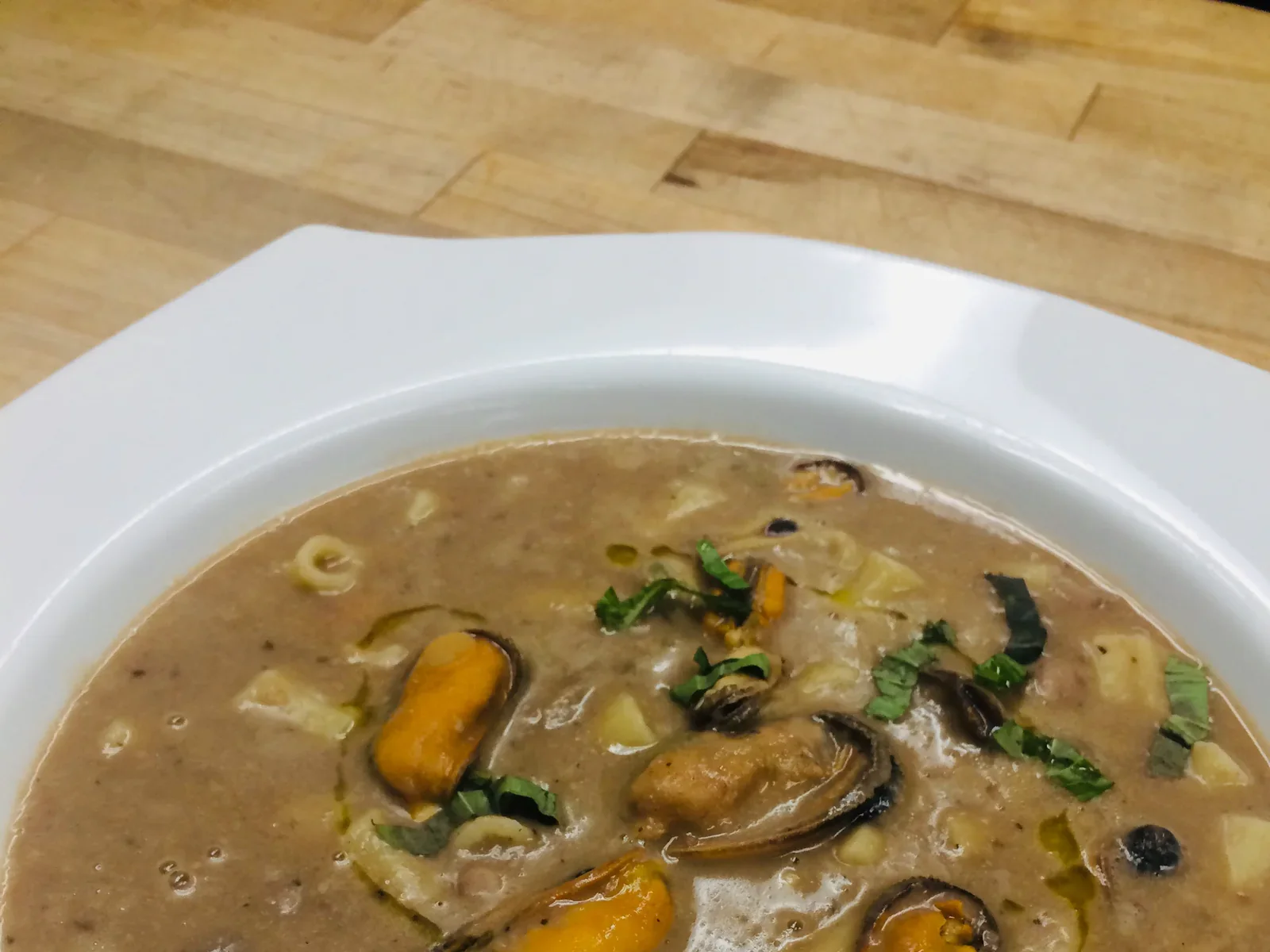
Chef Roberto’s Pasta Fagioli e Cozze alla Napoletana documented borlotti beans, mussels, garlic, and onions. The photograph shows how those elements meet. The puréed-looking beans give the bowl weight; pieces of pasta interrupt the softness; mussels add a saline, mineral note that lifts the earthy base. Garlic and onion join land and sea with sweetness and savor rather than forcing one to overpower the other.
The contrast works because mussels do not erase the identity of pasta e fagioli. They sharpen it. The bean still supplies comfort and body; the shellfish opens a window toward the Bay of Naples and Campania’s coastal table.
There is no single correct consistency
Arguments about whether pasta e fagioli should be soup, stew, or something nearly dry miss what the archive teaches. Consistency is one of the dialects of the dish.
Cooking pasta in the bean liquid creates a thicker result and binds the flavors. Cooking it separately can preserve a clearer broth and firmer pasta. Mashing some beans changes the texture without changing the core ingredients. Resting the finished pot often makes it denser as starch continues to absorb liquid.
Each choice changes the sensory experience. A brothy version gives separate spoonfuls of bean, pasta, and liquid. A thick version coats every piece, so the first impression is unified and the individual ingredients emerge as you chew. Neither is automatically more Italian. Both can express a place and a household.
A map drawn in bowls
Pasta e fagioli endures because it is specific and adaptable at once. Its two-name foundation is clear enough to recognize, yet open enough to carry a northern winter pantry, Tuscan herbs, a Brescian memory, or mussels from the Campanian coast.
That flexibility is not a weakness in the tradition. It is evidence of how traditions survive: people keep the idea useful, local, and worth repeating.
Explore more of Chef Roberto’s regional cooking in the weekend-special archive, or see Davanti’s current offerings on the menu.
Culinary details reviewed by Oliver Calza, Davanti Co-Founder.